
Every minute counts around an edgebander. When an operator has to walk around the machine to retrieve parts, the pace drops. The edgebander waits. Productivity drops with it.
The XPRS was designed to eliminate that detour. Simple, compact, and affordable, it automates the return of parts to the infeed of small and mid-sized edgebanders. The result: a more consistent workflow, reduced manual handling, and improved output — without redesigning your entire operating cell.
Before going further: if your line runs above 40 feet per minute (13 m/min) or you regularly process parts longer than 15 feet, we recommend considering the BT3, which is better suited for higher volumes and longer parts.
This buying guide is designed to help you determine whether the XPRS matches your production reality. You’ll find key features, tangible benefits, and essential criteria to evaluate before integrating a return conveyor into your edgebanding cell.
My name is Simon Lambert, Territory Sales Manager at Doucet since 2017. I hold a Bachelor’s degree in Mechanical Engineering and previously worked as a Project Manager and After-Sales Service Supervisor before moving into sales.
This hands-on experience has allowed me to deeply understand manufacturers’ challenges: production pace, floor space constraints, labor availability, and profitability. Through this guide, I aim to provide practical insights to help you select a solution aligned with your production environment and performance objectives.
TABLE OF CONTENTS
- Product Description
- Who the XPRS Is Designed For — and Who It’s Not
- Key Advantages
- Why Invest in an XPRS?
- Most Frequently Asked Questions Before Purchase
- Comparable Equipment and Competitor Positioning
- Expected Investment
- Conclusion
PRODUCT DESCRIPTION
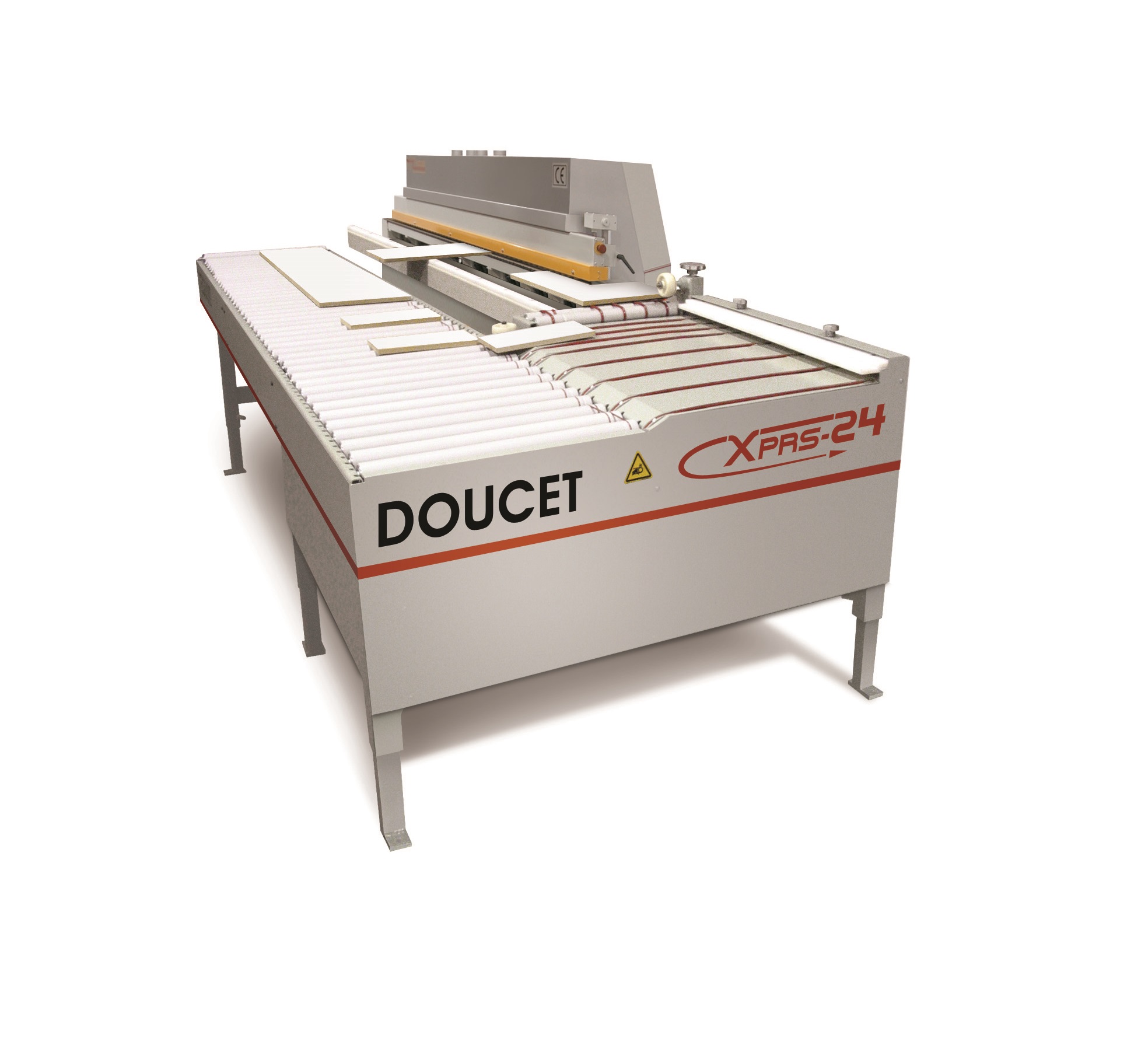
The XPRS is a return conveyor designed specifically for small and mid-sized edgebanders. Its purpose is clear: maintain continuous workflow around the machine without adding operational complexity.
A single operator can continuously feed the edgebander. The part exits the machine, travels along the return conveyor, and comes back directly to the infeed. The cycle immediately resumes. No walking around. No unnecessary stops.
The XPRS adapts to the required roller width and return length to match your edgebander. Its design is intentionally straightforward. No complex configurations. No unnecessary features. The goal is fast integration, intuitive operation, and consistent performance.
For additional details, consult the product page and technical specifications.
The XPRS is:
- Available with right-hand or left-hand return, depending on your machine orientation
- Offered in two models with 24" or 36" wide conveyors
Installation is performed by the customer using the provided documentation and guidelines. Its robust structure and proven mechanical design ensure simple setup and minimal maintenance.
 WHO THE XPRS IS DESIGNED FOR — AND WHO IT’S NOT
The XPRS is not for everyone. It addresses a specific production context. Before investing, it’s important to evaluate your volume, production speed, and work organization.
Ideal Profile
The XPRS is particularly well suited for mid-sized manufacturing operations looking to structure production around an existing edgebander.
Typically:
- Companies with more than 10 employees
- Regular edgebander usage
- A desire to increase efficiency without hiring
- A need to maintain continuous flow at the infeed and outfeed
In these environments, the edgebander is a strategic production asset. Every interruption slows the line. The XPRS optimizes machine utilization and reduces repetitive manual return tasks.
The objective is not complexity. The objective is stability and maximizing existing capacity.
Less Suitable For
The XPRS may not be ideal for:
- Small woodworking shops with 10 employees or fewer
- Shops where the edgebander runs occasionally
- Facilities with extremely limited floor space
- Businesses that prefer assigning two employees for a few hours rather than investing
In these cases, ROI may take longer. If the edgebander operates only a few hours per week, automation of part return may not justify the investment.
Some companies choose to allocate two team members for three hours instead. Depending on volume and priorities, that decision can be entirely rational.
High-Volume Scenario
The XPRS is not designed for:
- Very high production volume
- Speeds exceeding 40 ft/min (13 m/min)
- Parts longer than 15 feet
In those situations, production pace and dimensions require a more robust structure. The BT3 offers a design better suited for high-throughput environments and long parts.
Ultimately, the right choice depends on your usage frequency, production pace, available space, and growth strategy.
Below is a structured English version aligned with your positioning for XPRS (distinct from Feedback), using a professional, manufacturing-focused tone consistent with Doucet’s voice.
KEY ADVANTAGES
The XPRS delivers measurable gains within the first weeks of operation. It increases edgebander utilization by eliminating downtime associated with manual part return. It reduces operator movement around the machine, decreases fatigue caused by repetitive handling, and supports a more consistent production rhythm.
By better structuring the workstation, it improves ergonomics and operational flow. In many cases, the investment is justified by labor savings and measurable throughput improvements.
WHY INVEST IN AN XPRS?
The decision to invest in an XPRS often stems from concrete operational challenges: difficulty recruiting or retaining personnel for repetitive tasks, the need to optimize an existing edgebander, the desire to increase production without expanding the facility, or the search for the right balance between cost and performance.
Rather than investing in heavy automation, many manufacturers choose a targeted solution. The XPRS does not aim for over-automation. It focuses on smart efficiency — improving what you already have while supporting sustainable growth.
MOST FREQUENTLY ASKED QUESTIONS BEFORE PURCHASE
Before finalizing a decision, several technical aspects should be validated. Dimensions, available floor space, and cell configuration directly impact performance and integration.
What conveyor width should we choose?
The roller width must match your edgebander and the size of the parts being processed.
What return length is required?
The return length is determined by your cell layout. It must allow smooth part flow without creating congestion.
Are additional options required?
No. The XPRS was designed to remain simple and robust. The only decisions involve:
- Right or left return orientation
- 24" or 36" conveyor width
This limits variables, simplifies integration, and reduces startup time.
How much floor space is required?
Clear space behind and alongside the edgebander is required. Our team can help assess your available area to ensure proper integration.
Who performs the installation?
Installation is completed by the customer using the documentation and guidance provided by our team. No installation fees are required.
DIFFERENCES FROM COMPETITOR PRODUCTS
At Doucet, return conveyor manufacturing has been part of our core expertise for many years. This specialization has allowed us to build strong technical know-how and secure a significant market presence across North America.
The XPRS is not a generic add-on solution. It was engineered specifically for edgebanding environments: stable pace, easy integration, and mechanical reliability.
Our reputation is built on targeted, field-proven solutions designed for long-term durability. Each model addresses precise productivity and efficiency needs on the production floor.
COMPARABLE EQUIPMENT
Within Doucet’s lineup, the XPRS positions itself between fully manual handling and more robust systems such as the BT3.
It does not replace a solution designed for extremely high throughput or extreme production speeds. Nor is it intended for occasional-use workshops.
The XPRS is designed for manufacturers ready to take a structured step toward automation, offering the right balance between simplicity, performance, and investment.
EXPECTED INVESTMENT
The price of an XPRS primarily depends on the selected model and conveyor width required for your edgebander.
Indicative investment range: $20,000 to $30,000, depending on whether a 24" or 36" conveyor is selected.
As mentioned previously, no installation fees are required. The XPRS was designed for straightforward and efficient setup. Customers can perform installation using the provided documentation and guidelines.
Because it relies on a simple and robust mechanical design, the XPRS requires minimal maintenance. Regular cleaning and a few preventive checks are sufficient to ensure long-term performance and durability.
CONCLUSION
The XPRS does not try to do everything. It solves a specific need: improving the efficiency of a small or mid-sized edgebander without adding unnecessary complexity.
If your company is looking to save time, reduce manual handling, and maximize machine utilization, the XPRS represents a practical, accessible, and fast-paying investment.
If your production speed exceeds 40 ft/min or your parts exceed 15 feet in length, a more robust solution such as the BT3 may be more appropriate.
The key is alignment. Choosing equipment based on your volume, space, and strategic objectives.
QUESTIONS OR INFORMATION REQUEST
Do you have questions about this guide or the XPRS equipment?
Contact us today. Our team will be happy to assist you.
Three simple ways to reach us:
- Fill out our online Request for Quote form
- Email us at info@doucetinc.com
- Call us at 1-866-619-9965
With Doucet, every solution is designed to simplify your operations and drive your productivity forward.
