Precision Material Feeding at 150 Feet Per Minute
The MFE-150's capability to maintain consistent feed rates up to 150 feet per minute makes it ideal for medium to high-volume moulding operations requiring reliable, automated material handling.
Consistent Speed Control
Unlike manual feeding or basic roller systems, the MFE-150's lateral chain mechanism provides positive material control throughout the feeding process. The chain-driven system eliminates slippage, hesitation, or speed variation that compromises profile quality. Material moves at precisely the speed you set, maintaining dimensional accuracy and surface finish quality across every piece.
Accommodates Material Variation
Real-world production involves materials of different lengths—from short trim pieces to long boards. The MFE-150 seamlessly handles this variation without adjustment or reconfiguration. Whether feeding 2-foot sections or 16-foot boards, the system adapts automatically while maintaining the set feed rate.
Optimal Speed Range
The 150 feet per minute maximum capacity suits most trim, moulding, and millwork operations. This speed range balances high productivity with quality control, allowing sufficient time for profile formation while maintaining excellent throughput. For operations requiring even higher speeds, Doucet offers the MFE-300 model with 300 FPM capability.
How the MFE-150 Chain Feeder Works
Understanding the MFE-150's operating principle helps appreciate its advantages over alternative feeding methods.
Lateral Chain Drive Mechanism
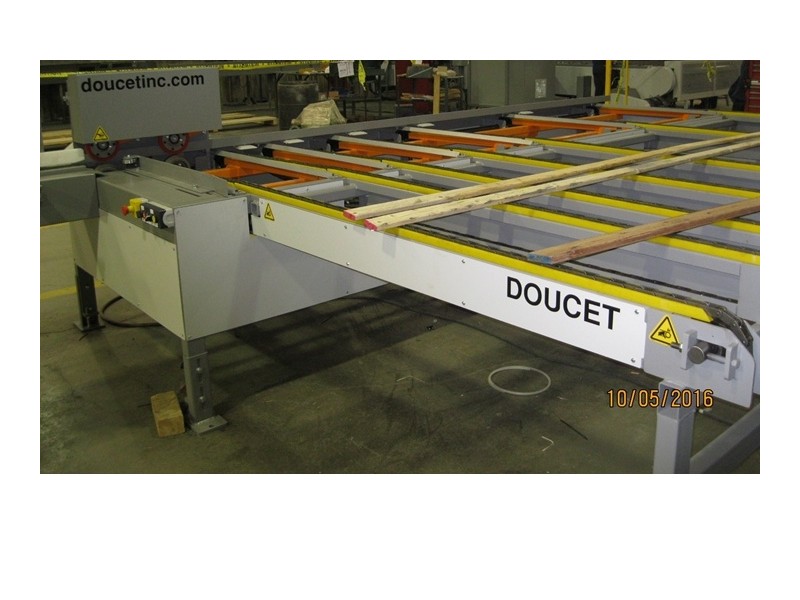
The MFE-150 utilizes lateral chains positioned along both sides of the material path. These chains feature specialized attachments that engage material edges, providing positive drive without surface contact that could mark or damage workpieces. The lateral positioning allows the chains to grip and propel material while leaving top and bottom surfaces free for moulder processing.
Synchronized Operation
The feeder's control system synchronizes chain speed with moulder operation. As you adjust moulder speed up or down, the MFE-150 automatically matches the feed rate, maintaining optimal material delivery without operator intervention. This synchronization prevents material pile-up, gaps, or feed rate mismatches that cause quality problems.
Continuous Material Flow
The chain system maintains constant forward pressure, ensuring materials enter the moulder smoothly and consistently. This eliminates the stop-start motion or irregular feeding that creates visible defects in finished profiles. Continuous flow also maximizes moulder utilization, reducing downtime and increasing pieces produced per hour.
Variable Length Handling
Advanced sensing and control logic allows the MFE-150 to automatically adjust for varying material lengths. Short pieces receive the same consistent handling as long boards, with the system managing transitions between pieces seamlessly. This versatility eliminates the need for manual sorting or separate feeding processes for different length materials.
Key Features & Technical Specifications
High-Speed Feed Rate Capability
Maximum Speed: 150 Feet Per Minute
The MFE-150 maintains consistent feed rates from slow precision feeding up to 150 FPM maximum capacity. Variable speed control allows optimization for specific profiles, materials, and quality requirements. The wide speed range accommodates both intricate detailed profiles requiring slower speeds and simple profiles where maximum throughput is desired.
Speed Accuracy
Precision drive system maintains feed rate accuracy within ±1%, ensuring dimensional consistency across production runs. This accuracy level prevents the slight speed variations that accumulate into measurable dimensional deviations over long production runs.
Variable Length Material Handling
Length Range
Minimum piece length: Typically 12 inches (configuration dependent)
Maximum piece length: Limited only by available space (up to 16+ feet common)
Handles mixed lengths in same production run
No adjustment required between different length materials
Automatic Length Detection
Photo-eye sensors detect material presence and length, adjusting system operation accordingly. The control system manages spacing between sequential pieces, preventing collisions while minimizing gaps that reduce productivity.
Robust Chain Drive System
Heavy-Duty Construction
Industrial-grade chain components designed for continuous operation in demanding woodworking environments. Heat-treated steel chains resist wear and stretching, maintaining precise operation over extended service life.
Minimal Maintenance Requirements
Sealed bearings and self-lubricating components reduce routine maintenance. The robust design minimizes downtime, with typical maintenance intervals measured in months rather than weeks.
Reliable Performance
The mechanical simplicity of chain drive systems provides inherent reliability superior to pneumatic or friction-based alternatives. Chains operate consistently regardless of material surface conditions, moisture content, or minor dimensional variations.
Precision Control and Synchronization
Electronic Speed Control
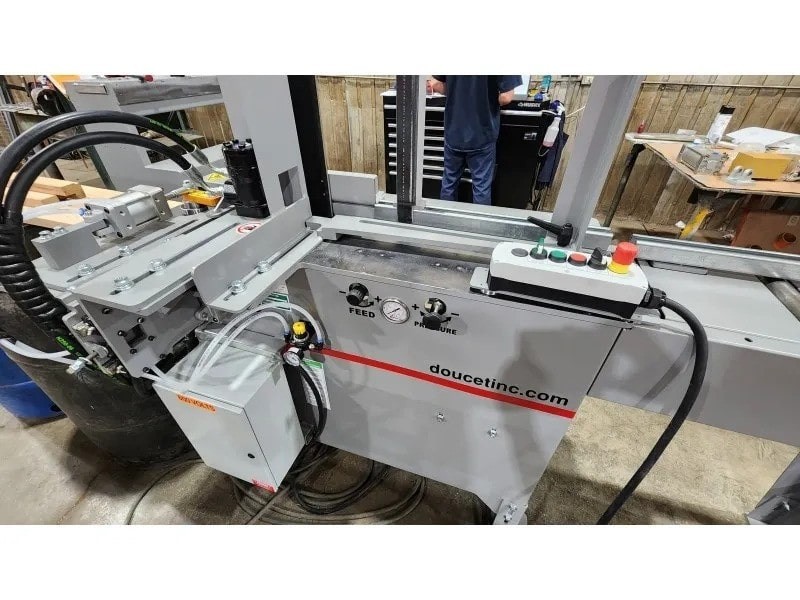
Digital control system provides precise speed adjustment and synchronization with moulder operation. Operator interface allows easy speed setting, with feedback confirming actual feed rate.
Moulder Integration
Optional electronic synchronization links feeder speed directly to moulder operation. When moulder speed changes, feeder speed adjusts automatically, maintaining optimal relationship without manual intervention.
Safety Interlocks
Integrated safety systems prevent operation when protective guards are open or when emergency stops are activated. Control logic coordinates with moulder safety systems for comprehensive protection.
Applications: Moulding Operations & Production Lines
The MFE-150 Lateral Chain Feeder excels in diverse woodworking applications where consistent, automated material feeding improves quality and productivity.
Trim and Moulding Manufacturing
Interior Trim Production
Manufacturers producing baseboards, crown moulding, chair rail, and other architectural trim benefit significantly from MFE-150 automation. The consistent feed rate ensures uniform profile depth and smooth surfaces across entire production runs. High-volume operations processing thousands of linear feet daily find the 150 FPM capacity ideal for maintaining productivity without sacrificing quality.
Exterior Trim and Siding
Exterior trim profiles, fascia boards, and decorative siding profiles require consistent material feeding to achieve weather-resistant joints and uniform appearance. The MFE-150's positive chain drive prevents the speed variations that create irregular profiles, ensuring tight-fitting joints and professional results.
Flooring Production
Hardwood Flooring
Flooring manufacturers rely on precise profile consistency for proper tongue-and-groove fit. The MFE-150 maintains the exact feed rates necessary for accurate profile dimensions, preventing the tight or loose fits that result from speed variation. Whether producing solid hardwood strips or engineered flooring components, consistent feeding ensures quality and reduces customer complaints.
Specialty Flooring Profiles
Custom flooring profiles including wide plank flooring, hand-scraped textures, and specialty edge details require careful feed control. The MFE-150's precision handling preserves the delicate surface treatments and edge profiles that distinguish premium flooring products.
Millwork and Custom Profiles
Custom Architectural Millwork
Millwork shops producing custom profiles for high-end residential and commercial projects require exceptional quality control. The MFE-150's consistent feeding eliminates the operator-induced variations common with manual feeding, ensuring every piece meets exacting standards.
Furniture Components
Furniture manufacturers producing moulded edge details, decorative trim, and profile components benefit from automated feeding's consistency. Complex profiles with multiple knife cuts require steady feed rates to achieve clean transitions and avoid tear-out or burning.
Industrial Wood Products
Manufacturers producing pallet components, crating materials, and industrial wood products use the MFE-150 to maximize throughput while maintaining dimensional accuracy necessary for automated assembly processes.
Benefits of the MFE-150 Moulder Feeder
Investing in MFE-150 automation delivers measurable improvements across multiple operational metrics.
Consistent Feed Rate for Quality Results
Eliminates Operator Variation
Manual feeding inevitably introduces speed inconsistencies as operators tire, become distracted, or adjust their rhythm. These variations appear as visible defects in finished profiles—irregular depths, wavy edges, or inconsistent surface textures. The MFE-150 eliminates human-caused variations, delivering identical feed rate piece after piece, shift after shift.
Prevents Common Defects
Blade marks: Caused by feed rate too slow or inconsistent
Burn marks: Result of material hesitation in cutterhead
Tear-out: Often caused by speed variation during cutting
Chatter marks: Produced by uneven feeding pressure
Dimensional variation: Accumulates from slight speed changes
Automated feeding eliminates these quality issues, reducing waste and improving customer satisfaction.
Professional Surface Finish
Consistent feed rates produce smooth, professional surface finishes that minimize or eliminate sanding requirements. This time and labor savings compounds across high-volume production, significantly impacting profitability.
Reduced Material Waste
Fewer Defective Pieces
By preventing feed-rate-related defects, the MFE-150 significantly reduces scrap rates. Even a 2-3% waste reduction across high-volume production represents substantial material cost savings that contribute to rapid ROI.
Optimized Material Usage
Consistent feeding allows tighter production tolerances, reducing the safety margins often built into manual operations. More usable product from the same material input directly improves material yield and profitability.
Reduced Setup Waste
The MFE-150's quick speed adjustment and consistent operation minimize the setup pieces required when changing profiles or materials. Faster achievement of optimal settings means less material consumed during production startups.
H3: Improved Operator Safety
Eliminates Hand-Near-Cutterhead Risks
Manual moulder feeding requires operators to maintain hand positions dangerously close to rotating cutterheads. This proximity creates serious injury risks, particularly during long shifts when fatigue reduces attention and reaction time. The MFE-150 completely eliminates this hazard by handling all material feeding automatically.
Reduces Repetitive Motion Injuries
Manual feeding involves repetitive pushing, guiding, and lifting motions that lead to cumulative stress injuries affecting shoulders, wrists, and backs. Automated feeding removes these repetitive tasks, reducing injury rates and associated workers' compensation costs.
Prevents Kickback Incidents
Moulders can violently kick back material if it binds or catches unexpectedly. Operators manually feeding material face direct exposure to these dangerous kickback events. The MFE-150's positive chain drive maintains control throughout the process, and operators stand safely away from potential kickback zones.
Improved Workplace Culture
Demonstrating commitment to worker safety through equipment investments like the MFE-150 improves employee morale, retention, and workplace culture. Safer operations reduce insurance premiums and create more attractive employment opportunities.
Increased Production Throughput
Maintains Maximum Sustainable Speed
Human operators cannot sustain maximum feed rates for entire shifts. Fatigue, breaks, and attention lapses naturally slow manual feeding below theoretical capacity. The MFE-150 operates at set speeds continuously, hour after hour, maximizing actual production output versus theoretical capacity.
Eliminates Feed Interruptions
Manual feeding requires brief pauses as operators position new pieces, adjust their stance, or clear sawdust. These micro-interruptions accumulate to significant lost production time. Automated feeding maintains continuous material flow, converting those accumulated minutes into substantial additional output.
One Operator Manages Multiple Processes
With feeding automated, one operator can manage material preparation, quality inspection, finished product handling, and other value-added tasks simultaneously. This labor efficiency multiplies the MFE-150's productivity benefits beyond simple speed increases.
Quantified Productivity Gains
Typical operations report 15-25% throughput increases after MFE-150 installation, representing thousands of additional linear feet produced weekly. This capacity expansion often delays or eliminates the need for additional moulder purchases.